Face-lit, halo-lit or plain: choosing 3D letter signage
Fabricated 3D letters are the most common way a business puts its name on a building, and the biggest decision after the artwork is how they are lit. There are three main options. Each changes how the sign looks at night, how far away it can be read, what it costs and what the wall behind it needs to be.
Face-lit letters
Face-lit letters have LEDs inside a metal or acrylic return, and the light comes out through a translucent acrylic face. The whole face of each letter glows evenly.
This is the brightest option and the most legible from a distance, which is why it is the standard for retail fascias, petrol stations and anything that has to be read from a road. The face can be almost any colour, and a vinyl overlay can match a brand colour exactly.
- Best for: shopfronts, roadside and high-mounted signs, dark evenings.
- Watch for: an uneven glow. Cheaper builds put too few LEDs too close to the face, and you see hot spots. Ask how deep the letters are and how the LEDs are spaced.
Halo-lit letters
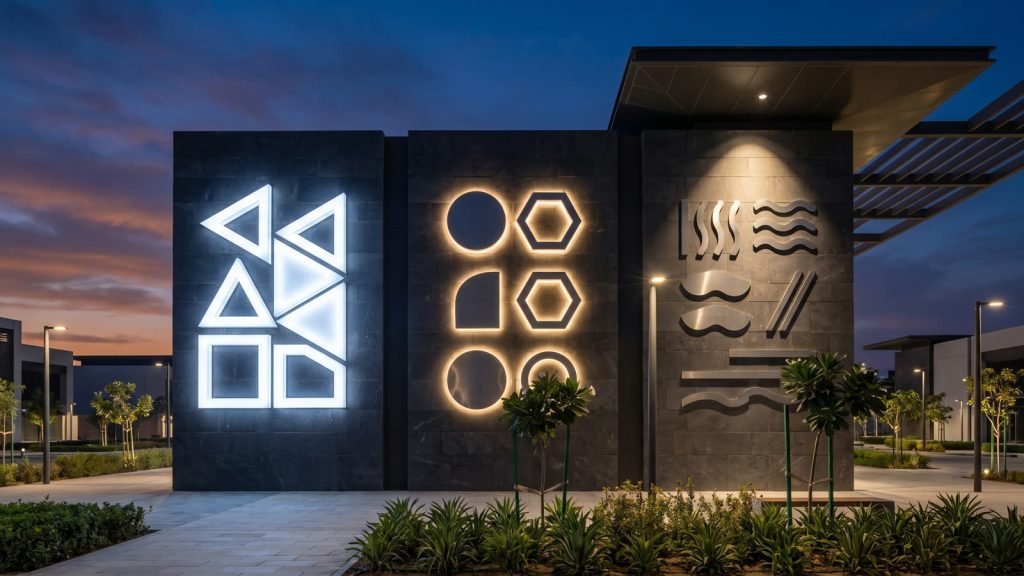
Halo-lit letters, also called reverse-lit or back-lit, have a solid face, often brushed stainless steel or painted aluminium. The LEDs shine backwards onto the wall, so each letter is outlined by a soft glow while the face itself stays dark.
The effect is quieter and more expensive-looking, which suits hotels, offices, clinics and reception walls. It depends heavily on the wall. The letters have to stand off the surface so the light has room to spread, and a light, matte wall shows the halo best. On a dark or very reflective wall the glow weakens or turns into sharp reflections.
- Best for: premium brands, lobbies, building identity at close to medium distance.
- Watch for: legibility at long range. A halo reads beautifully at 20 metres and far less clearly at 80. Thin letterforms lose the most.
A combination of the two, with a lit face and a halo, gives brightness and depth at once. It costs the most and is usually kept for flagship signs.
Non-illuminated letters
Plain letters have no internal lighting. They rely on daylight, the building’s lighting, or small spotlights aimed at them. They cost the least, need no wiring to each letter and nothing inside them can fail.
They work well indoors, in well-lit reception areas and on buildings that are mostly visited during the day. Outdoors at night they disappear unless the wall is lit.
How big should the letters be?
A widely used rule of thumb for signage is about 25mm of letter height for every 3 metres of viewing distance. A sign meant to be read from 30 metres needs capital letters of roughly 250mm. Halo-lit letters benefit from going a size up, because the outline is softer than a glowing face.
Questions to settle before you order
- Where will people read the sign from, and at what distance?
- What is the wall made of, and what colour is it? This decides whether a halo will work.
- Is there power close to the sign location, and can a technician reach the driver later?
- Does the landlord, mall or building management need drawings before installation? External signs in the UAE generally need approval, so ask early.
- Is there an opening date? Fabrication, approvals and installation all need time, and approvals are often the slowest part.
LEDs themselves are rated to run for tens of thousands of hours. The part that usually fails first is the power driver, especially in hot enclosures, so a good installation puts it somewhere a technician can reach without taking the letters off the wall.